As warehouse leases approach decision time, many operations face a familiar question:
Should we renew our lease or is it time to relocate?
There is no universal right or wrong answer. The best decision that can be made is dependent on factors that vary from operation to operation and site to site. An important question to reflect on is: how well does your current facility support today's operation and tomorrow's growth? The structured approach to this question requires evaluation beyond the expected square footage and rent comparison. To make this decision with confidence there needs to be evaluation on the efficiency, layout, flexibility, and long-term cost associated with both options.
The Case for Renewing Your Warehouse Lease
Renewing a lease often feels like the simpler choice. If your current location works and the disruptions of a move is overly concerning. Staying put might be the right move.
For many businesses, renewal becomes a smart option when paired with layout optimization or racking reconfiguration. Even within the same footprint, significant efficiency gains can be achieved by redesigning storage, improving flow, and better utilized vertical space.
PROs:
- Minimal operational downtime
- Lower upfront costs compared to a full relocation
- Existing workforce familiarity with the site
- Established transportation routes and carriers
CONs:
- Space constraints that limit growth
- Layout designed for past operations, not current demand
- Aging infrastructure or building limitations
- Missed opportunities to improve efficiency
Renewal makes the most sense when the facility can be reimagined not just reused.
The Case for Relocating Your Warehouse
Relocation opens the door to a fresh start. Starting fresh allows you to evaluate new buildings, locations, and floor plans that can solve challenges that simply can't or won't be fixed within your existing space.
Relocation often makes sense when growth is outpacing capacity or when inefficiencies are baked into the building itself.
PROs:
- Ability to design a layout around current and future operations
- Improve ceiling height, column spacing, and dock configurations
- Potential labor or logistics advantages in a new location
- Opportunity to upgrade racking system and material flow
CONs:
- Higher upfront costs
- Temporary operational disruption
- Time-intensive planning and coordination
- Risk of replicating old inefficiencies in a new space
Without careful planning, a move can simply recreate the same challenges, just in a different building.
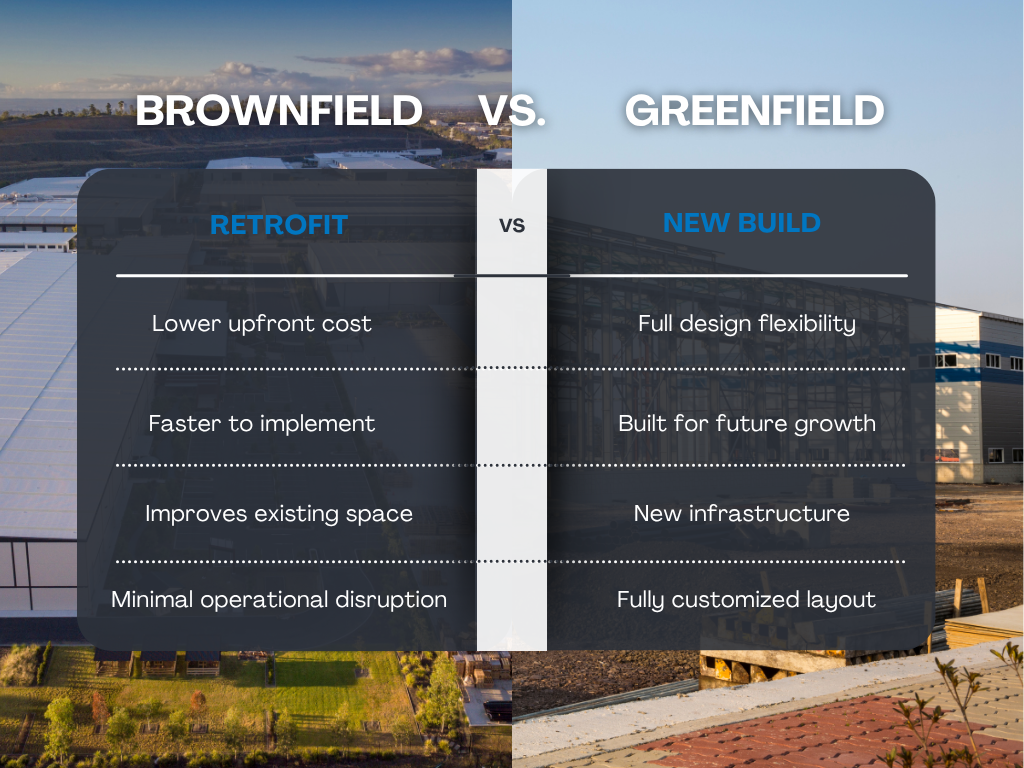
Brownfield vs. Greenfield: Another Factor to Consider if Relocating
If relocation becomes the right path, the next consideration is what type of facility to move into. Often this decision is between a brownfield and greenfield approach.
A brownfield site is an existing warehouse that is renovated or reconfigured for a new operation. This option can reduce construction time and upfront costs, but the building may come with structural limitation such as column spacing, ceiling height, or dock configuration that impacts layout and efficiency.
A greenfield project involves building a new facility from the ground up. While it requires more time and investment, it allows the building to be designed around the operation, from optimized racking layouts to future automation and expansion.
The key question when deciding brownfield vs greenfield remains the same: does the facility support your operation today and allow room for tomorrow's growth?
A Strategic Partner Makes the Difference
Whether you renew or relocate, the smartest decisions start with an operational evaluation not just a lease discussion. That's where a strategic partner adds the most value.
At McGee, we help businesses assess current layouts, identify inefficiencies, model optimized racking and space utilization, and support planning, whether that means reconfiguring your existing space or designing a new one. Our role isn't to push you toward moving or staying, but to ensure whichever path you choose is grounded in performance, flexibility, and long-term value.
With the right guidance, you gain clarity, reduce risk, and make a confident, strategic decision, one that positions your warehouse to perform better today and scale for tomorrow.